In a world where brands are constantly rethinking their inventory management....
....and how to ensure they are always maximizing sales while minimizing overstock – pre-orders often come up in exec circles as a solution.
The conversation typically kicks off as something like:
"Can we sell more if we launch it earlier? -> Launch it on pre-order first!"
"Can we sell even though the stock is delayed? -> Put it on pre-order!"
"Can we sell to bridge a temporary inventory gap instead of Notify Me? -> Flip it to pre-order!"
"Can we keep selling and not miss out through peak demand moments? -> Roll it over to pre-order!"
"Can we sell before we make it to see how much to make? Let's try pre-orders!"
With the commitment to launch pre-orders as a path towards better inventory management, the executional journey begins.
The scaling problem nobody talks about
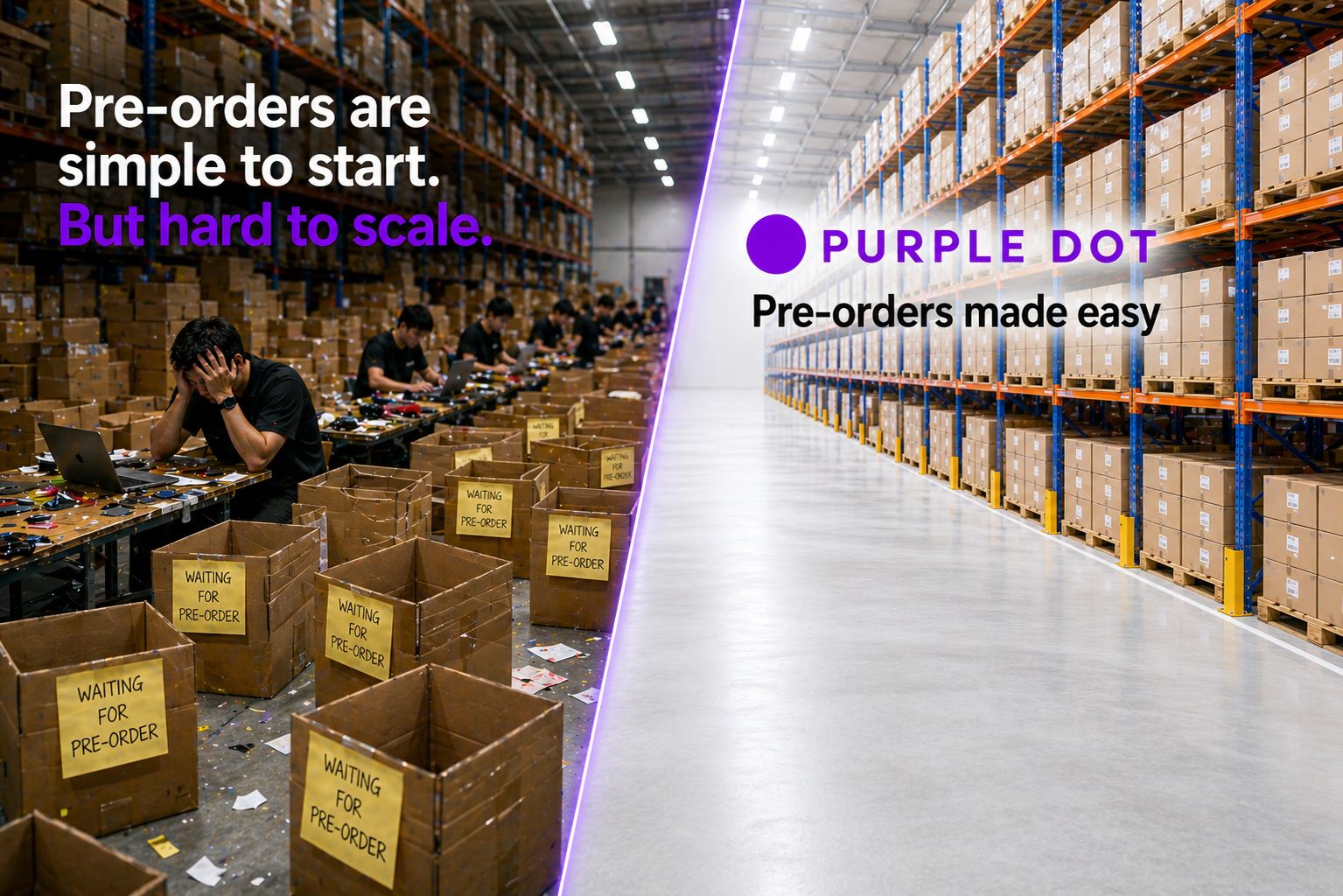
Here's the thing: Getting pre-orders started is easy. Scaling them is where everything breaks.
In the early stages, while your business is exploring pre-orders at a small scale, a simple pre-order app or a collection of internal workarounds can be a reasonable stopgap. And there are plenty of options on Shopify, tools like Timesact, PreOrder Globo, or PreProduct — that let you add a pre-order button to out-of-stock products. They work great at low volumes or for testing things out – when you're processing a handful of pre-orders a week and can manage the operational overhead manually.
But as you scale, those approaches start to show their cracks - and you need to be prepared on what's coming, as the problems tend to compound quickly:
- The warehouse melts down. Simple apps don't guarantee warehouse compatibility. At low volumes, you work around this with manual processes. At scale, you end up with exception queues piling up, mixed orders that can't be fulfilled, and half-packed boxes sitting on the floor. Your ops team starts dreading pre-order days, and makes moves to try to halt your pre-order strategy.
- Customer experience deteriorates. Without automated, dedicated communication workflows, customers don't know what's happening with their order. When delays hit - and at some point they will - support tickets flood in. The pre-order program that was supposed to drive revenue starts eroding customer trust.
- FTC compliance becomes a real risk. Most brands running pre-orders manually aren't keeping up with FTC requirements around customer funds, delayed shipments, customer notifications, and cancellation rights. For small brands, it's low risk. At scale, it's a liability that can result in significant multi-million dollar fines.
- Payment logistics get complicated. Split orders, deferred revenue recognition, partial shipments - your finance team and your payment processor need these flows to actually work out-of-the-box. Simple apps or workarounds don't address this complexity.
- Operations become unsustainable. Putting products on pre-order manually, tracking incoming purchase orders, flipping items back to in-stock when inventory arrives - at scale, this is a full-time job that still gets things wrong.
That's why we built Purple Dot. For your next step to get it right (or to avoid the pain in the first place).
A pre-order strategy is more than a pre-order button
The reason execution often breaks down in the earliest stages is because a pre-order strategy is not just swapping your "Add to Cart" CTA with a "Pre-Order" button. That's a tactic to try.
Instead, a pre-order strategy fits within your core inventory management - including the expertise, platform, and operational processes that fundamentally allows your business to approach inventory in a more flexible, less rigid way. When done right, your pre-order strategy runs like clockwork alongside your in-stock operations, enabling you to consistently sell products days, weeks, months or even a year before they arrive at your warehouse.
The brands who get this right treat pre-orders as a core revenue channel that transforms their overall inventory management strategy - for the better. With more control and more flexibility over when they can sell, brands are more forward-thinking now more than ever in figuring out how to sell more and store less.
Purple Dot: Enabling a pre-order strategy at scale
We proudly work with the world's biggest brands including Mattel, Timex, Kendra Scott, Tonies, Oh Polly, Tibi, Oak + Fort - to get pre-orders right at scale. Not as a side feature. Not as a band-aid to get them out of trouble. As a core part of how they do business.
What does that actually mean in practice? It means a complete operational foundation that gets the details right, so pre-orders become a strategic part of your inventory management - not just a tactical workaround.
- Guaranteed warehouse compatibility. We either hold inventory outside the standard fulfillment flow or we integrate with your ERP so orders don't pile up and confuse your warehouse. No meltdowns. No exception queues. Your 3PL or in-house ops team works the way they always have - fulfilling orders when the stock is available.
- Full FTC compliance, guaranteed. Every pre-order processed through Purple Dot meets FTC requirements for funds flow, customer notification, cancellation rights, and shipment timelines. This isn't an optional add-on - it's built into the platform. You sell pre-orders worry-free.
- End-to-end automation. From purchase order to fulfilment, our AI automates the entire lifecycle. Putting products on pre-order, customer communications, inventory allocation, payment capture, status updates - your team doesn't have to touch it.
- A trusted third party for high-conversion checkout. Purple Dot is the only approved pre-order Shopify Payments Partner. This means we can guarantee the customers' pre-order for their peace of mind, with very high conversion. Think Klarna for pre-orders.
- A dedicated partner, not just a tool. Every brand on Purple Dot gets white-glove onboarding, a dedicated success manager, and 24/7 support. Our team helps you build the right pre-order strategy for your business, handles the setup, and ensures your pre-commerce program is a success from Day 1 and improves over time.
The Results of a Pre-order Strategy
- Timex generates millions in additional annual revenue by launching collections two weeks early on pre-order.
- Makesy drove $2M in additional revenue in their first year by never truly going out of stock on best sellers.
- Oak+Fort saw a 25% increase in sales!
If pre-orders are becoming a meaningful driver of revenue or if that is your ambition, you'll want the right infrastructure and partner to support that growth. A simple app or quick workaround may have been enough to get started, but scaling a pre-order strategy takes a more robust foundation and expert partner — that’s our sweet spot.
It's why household names choose Purple Dot. And it's why we'd love to show you what it can do for your brand.